

Burning Man 2026 takes place in the Black Rock Desert of Nevada from August 30 to September 7, 2026. More than 70,000 participants will build a temporary city under the theme Axis Mundi. The theme centers on the cosmic pillar and our connection to the earth and the natural world.
This is a seven-day gathering, not a weekend festival. It runs on radical participation, large-scale art, and total self-reliance in one of the harshest environments in the American West.
Key Takeaways
- Burning Man 2026 runs August 30 to September 7 in Black Rock City
- The 2026 theme Axis Mundi centers on cosmic connection and unity
- Over 70,000 participants build a temporary city that leaves no trace
- The Man burns September 5; the Temple burns Sunday, September 6
- No headliners, no vendors, no trash cans: participation is required
Event Schedule And Key Dates
Burning Man 2026 spans a full week of arrival, building, art, and burning. Most participants arrive between August 28 and 30 as the city takes shape. Builders and artists work well beyond that window on both ends.
The week follows a loose but real rhythm. The early days center on arrival, camp setup, and exploring the art. The energy builds toward the weekend, when the two signature burns bring the city together.
The two burns carry very different moods. The Man’s burn is a roaring, joyful spectacle for the whole city. The Temple burn is silent and reflective, often devoted to grief and remembrance.
The key 2026 dates are confirmed by the Burning Man Project and echoed in independent travel coverage:
- Event dates: August 30 to September 7, 2026
- Gates open: Sunday, August 30, 2026
- The Man burns: Saturday, September 5, 2026
- The Temple burns: Sunday, September 6, 2026
- Exodus: Monday, September 7, 2026
What A Week At Black Rock City Looks Like
There is no official schedule at Burning Man, and no one will hand you one. The art installations, theme camps, and mutant vehicles are the program. Each participant builds their own week from what the city offers.
The opening days are about settling in. Newcomers set up camp, orient to the circular street grid, and start exploring on foot or by bike. The scale takes time to absorb, since the city stretches for miles.
The middle of the week is the creative peak. Roughly 400 theme camps offer workshops, talks, performances, and gifts around the clock. Art cars roam the open playa, and installations reveal themselves differently by day and night.
The final weekend turns toward release. The Man burns on Saturday in a citywide celebration, and the Temple burns on Sunday in near silence. Exodus then begins, and within days no trace of the city remains.
Some pointers for navigating the week:
- Pace yourself. Seven days in the desert is a marathon, not a sprint.
- Explore day and night. Many installations transform completely after dark.
- Bring a bike. The city is too large to cross comfortably on foot.
- Follow the art, not a clock. The best moments are usually unplanned.
What Axis Mundi Actually Means
The 2026 theme draws on an idea found across dozens of ancient cultures. An axis mundi is a central pillar or cosmic tree linking earth to the heavens. To the Maya it was the Ceiba tree, to the Norse it was Yggdrasil, and to the Celts the Crann Bethadh.
Burning Man reframes its own wooden effigy through this lens. The Project casts the Man as its version of the cosmic tree. In its announcement it described the Man as a Jacob’s Ladder connecting us to the unseen and unknowable.
The theme also carries a social meaning. It celebrates interconnectedness, shared social realities, and our ties to the natural world. The image is a still center around which a scattered global community spins.
The theme shapes everything built on the playa. It guides the Man Pavilion, the Temple, the art grants, and how camps and individuals design and dress. For 2026, it is the conceptual frame for the entire city.
Theme And Art Highlights
Black Rock City is one of the largest immersive art events in the world. The 2026 program funds 75 Honoraria projects with $1.3 million in grants. These artists come from 15 countries and 17 US states, part of nearly $6 million in annual arts funding.
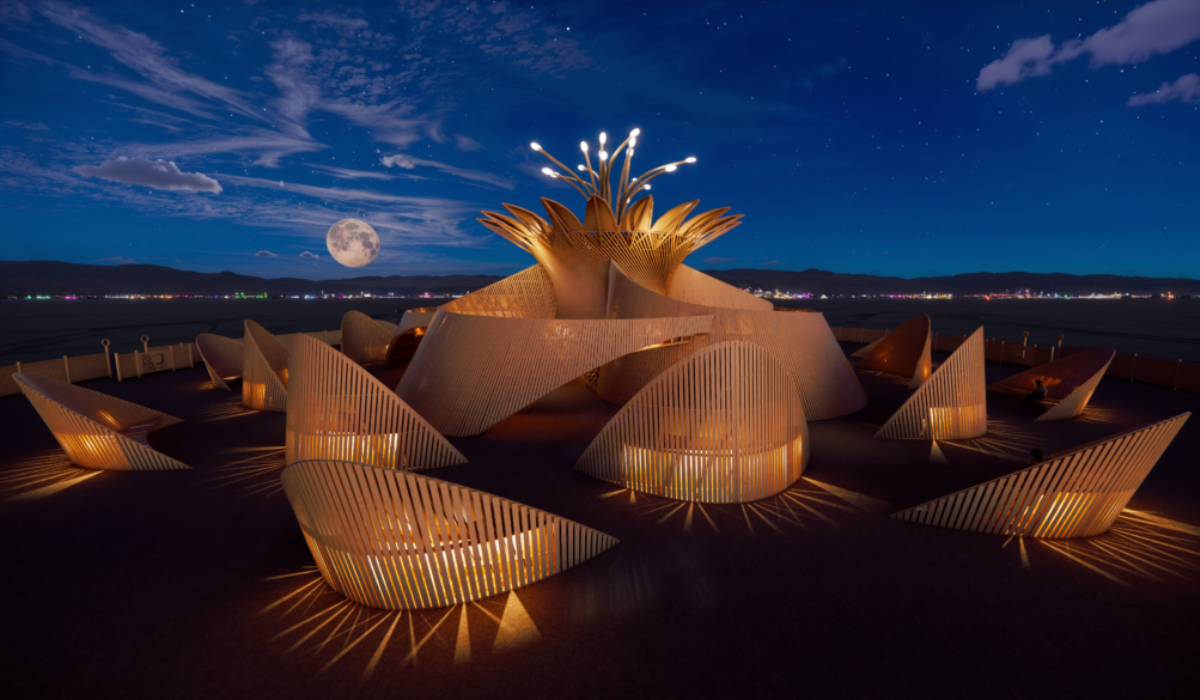
The Man Pavilion makes the theme physical. Named Cryptomeria and designed by Alexander “Zander” Rose, it draws on Japan’s ancient Jōmon Sugi cedar, estimated at 2,170 to 7,200 years old. Its double-helix pathway invites participants to stand at the axis between earth and sky.
The Temple is the city’s emotional center. The Temple of the Moon, by James Gwertzman and the Moonlight Collective, draws on the Queen of the Night, a cactus flower that blooms for a single evening. It honors impermanence and the cycle of appearance and release.
Standout 2026 art anchors include:
- Cryptomeria: the Man Pavilion, rooted in an ancient Japanese cedar.
- Temple of the Moon: the reflective sacred space that burns on the final Sunday.
- Octopolis: a large installation by LaynaJoy Rivas and the Big Art Collective.
- The Circle of Ancestors: a community-focused work by Maurice Cavness.
- Resilience: a fire sculpture of a tardigrade, the near-indestructible water bear.
The City That Vanishes
Black Rock City is a temporary metropolis built from nothing. It rises on an ancient dry lakebed near Gerlach, roughly 120 miles north of Reno. For one week it becomes a city of more than 70,000 people from over 100 countries.
The city is organized around a circular street grid. At its center stands the Man, the effigy that anchors the whole event. Nearly 400 temporary art installations and theme camps fill the space around it.
The defining rule is that everyone is a participant, not an audience. There is no stage, no headliners, and no schedule anyone will hand you. The population is capped by a Bureau of Land Management permit to limit environmental impact.
Ephemerality is the point of the whole endeavor. The city stands for just eight days, then disappears without a trace. There are no trash cans anywhere, so participants pack out everything they bring.
The Principles Of Burning Man
The event runs on shared values rather than strict rules. The top Principles were written in 2004 by co-founder Larry Harvey. They describe the culture’s ethos and guide how the community builds Black Rock City.
The first five focus on the individual and the economy of the playa:
- Radical Inclusion: anyone may join the community, with no prerequisites.
- Gifting: giving unconditional gifts, with no expectation of return.
- Decommodification: no sponsorship, advertising, or commercial trade.
- Radical Self-reliance: discovering and relying on your own inner resources.
- Radical Self-expression: sharing unique personal gifts without outside control.
The next five focus on community and environment:
- Communal Effort: creative cooperation and collaboration.
- Civic Responsibility: valuing public welfare and community.
- Leaving No Trace: cleaning up completely and respecting the land.
- Participation: a doing-based ethic over passive spectating.
- Immediacy: valuing direct, present-moment experience.
Survival And Preparation
The environment is as extreme as the culture is open. Daytime heat tops 100°F (38°C), while nights drop toward freezing. Alkaline dust storms and sudden whiteouts are routine on the open playa.
Radical self-reliance is a practical necessity, not just a principle. There are no vendors or trash cans in Black Rock City. You must pack in and pack out everything you need for the full week.
Essentials to bring for 2026 include:
- Water: at least 1.5 gallons per person per day.
- Food: enough for the entire week, since nothing is sold on the playa.
- Eye and lung protection: goggles and N95 dust masks for dust storms.
- A bicycle: the primary way to move around the large city.
- Warm layers: for the near-freezing desert nights.
The trip in and out demands patience too. Gate traffic can turn the final stretch into a multi-hour crawl during peak times. Budget several hours for the last leg during peak arrival and departure.
Tickets And Access
Tickets are sold only through official channels. The Main Sale is the primary public sale through the Burning Man ticketing system. STEP is the official resale program, and unofficial sources should be avoided.
Every ticket grants the same access to Black Rock City. There is no VIP tier, in keeping with the Decommodification principle. Tiered pricing exists mainly to support access and fund the arts.
The honest takeaway is that this is not an event you can wing. First-timers most often underestimate how much preparation it takes. Check official updates, volunteer resources, and guidelines through the Burning Man Project.
Digital Trendings is your trusted source for AI news and updates, stay tuned for more.


