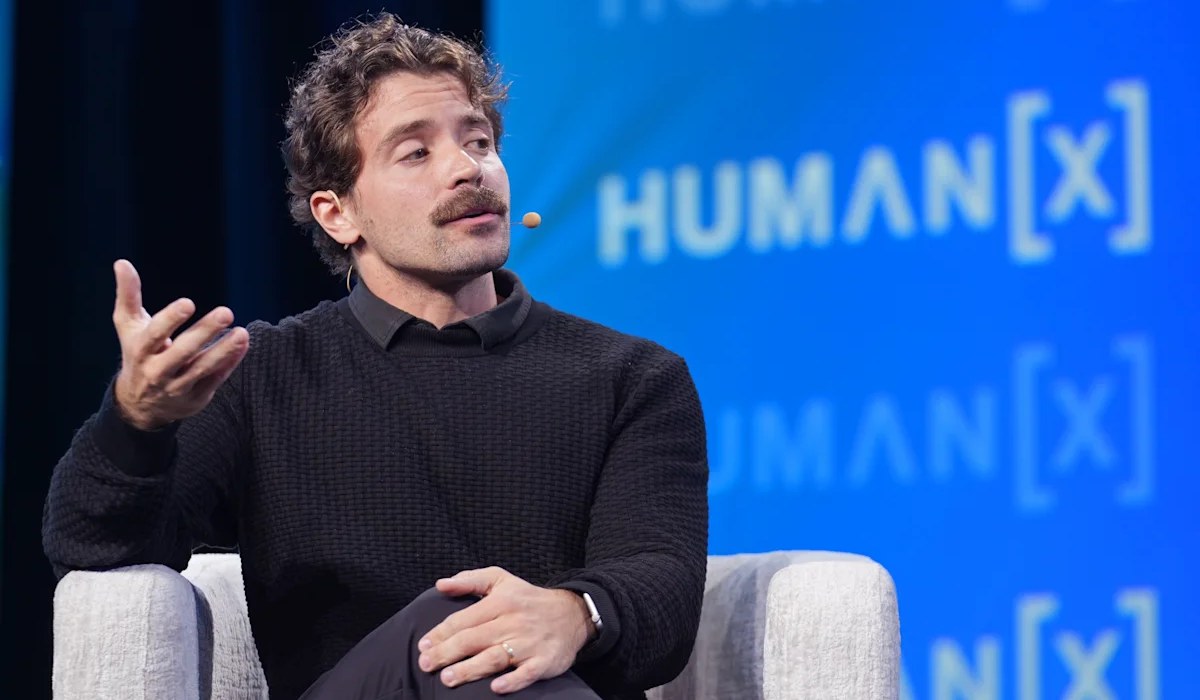


Vercel’s Guillermo Rauch sees a dividing line forming in AI: bundle the model and agent into one closed product, or keep them separate and swappable. He’s betting hard on the second. In a post-conference interview, he laid out why he wants Vercel to be the AWS of this generation.
Key Takeaways
- Rauch wants AI models and agents kept separate and swappable
- He frames Vercel as “the AWS of this generation”
- Vercel sees 6 million deployments daily, half from coding agents
- Over 1 trillion tokens flow through its AI gateway each day
- Companies are moving from one-lab bets to plug-and-play stacks
The Core Argument: Uncoupling Models From Agents
Rauch’s central claim is that the industry is at a fork. In a conversation with TechCrunch after Vercel’s ShipNYC conference, he framed the moment as deciding whether the model and the agent will be coupled, meaning whether you get all your intelligence from one place or assemble it from separate pieces.
His preference is modularity. He argues that treating the model as a building block you layer other components on top of mirrors how software engineering has always worked, with interchangeable parts rather than a single sealed system.
The stakes, in his telling, are about openness. Rauch positioned Vercel as fighting for a world of open protocols, casting the fight over coupling as a fight over whether developers stay free to mix and match.
The ambition behind it is not small. He wants Vercel to be the AWS of this generation, the neutral infrastructure layer everyone builds on rather than one more walled garden.
Vercel’s Quiet Rise in AI Infrastructure
For a company that isn’t a household name, Vercel sits at a surprising center of gravity. It has become one of the most central companies in AI software, largely by hosting the flood of code that agents now produce.
The scale is striking. The company sees 6 million deployments a day, half of them triggered by coding agents, and more than 1 trillion tokens flow through its AI gateway daily.
It’s a classic picks-and-shovels position. As AI generates an ever-larger glut of software, someone has to deploy and host it, and Vercel has aimed its tools at both human developers and the agents increasingly doing the building.
That backdrop explains Rauch’s confidence. Sitting on infrastructure that both camps depend on gives him a vantage point on where the whole ecosystem is heading.
The Two “Killer Apps” for Agents
Rauch describes last year as a period of pure experimentation, with hundreds of agents built and deployed inside Vercel itself. The real lessons came when those agents hit production, and they pointed to two standout uses.
The first is the coding agent. It drives enormous token consumption, and crucially, it produces mountains of software that then needs somewhere to live, which feeds directly back into Vercel’s core business.
The second is the internal corporate agent. Rauch offered a concrete example: a Vercel sales rep focused on growing existing accounts whose real bottleneck was never creativity or skill, but access to her own company’s data.
The old way was painfully slow. She previously would have had to wait for a dedicated dashboard project to finish before she could ask which accounts had added the most seats recently. An internal agent lets her ask on demand, collapsing a quarter-long wait into a question.
Solving the Data Problem: Eve and Sandbox
Internal agents raise a hard question: how do you let an agent touch company data without losing control of it? Vercel’s answer comes in two tools.
The first is a framework called Eve, which lets teams lay out an agent’s instructions and skills in plain natural language rather than brittle code. It’s meant to make agent behavior legible and auditable.
The second is Vercel Sandbox, which Rauch likens to putting the agent in a little cage. The agent stays free to use its intelligence, but administrators can set policy on what data it can access and what data is allowed to leave the sandbox.
The risk this guards against is real. Rauch pointed to a scenario where the wrong coding tool, installed in the wrong setting, could train on an entire proprietary codebase, recalling a conversation with an Airbus executive about decades of specialized aerospace code potentially leaking out to the cloud.
The Shift Away From Single-Lab Bets
Rauch says he’s watching how companies buy AI change in real time. A year ago, many picked a single lab partner and vowed to build everything on OpenAI or Anthropic.
That’s giving way to a modular mindset. Now, he says, customers understand the full stack, model, harness, data platform, sandbox, gateway, and treat every piece as plug and play, swapping components to fit the task.
The model layer is fragmenting too. Rauch highlighted growing adoption of Google’s Gemini models, driven by price and performance tuning, alongside open models like DeepSeek and GLM 5.2. That diversity is exactly the world his uncoupling argument is built for.
Why It Matters
At its heart, this is a fight over lock-in. If models and agents stay fused, intelligence flows from a handful of closed providers; if they stay separate, developers keep the leverage to choose, compare, and switch.
Vercel’s own trajectory shows why Rauch is pressing the point now. The company’s revenue has climbed sharply on the back of the agent boom, and Rauch has openly signaled it’s operating with public-company discipline, positioning it as core infrastructure for a market he says has no ceiling.
The outcome is still unsettled. Whether the industry lands on coupled, all-in-one AI products or the open, swappable stack Rauch is championing will shape how software gets built for years, and who controls it. For now, he’s placed Vercel firmly on the side of keeping the pieces apart.
Digital Trendings is your trusted source for AI news and updates, stay tuned for more.