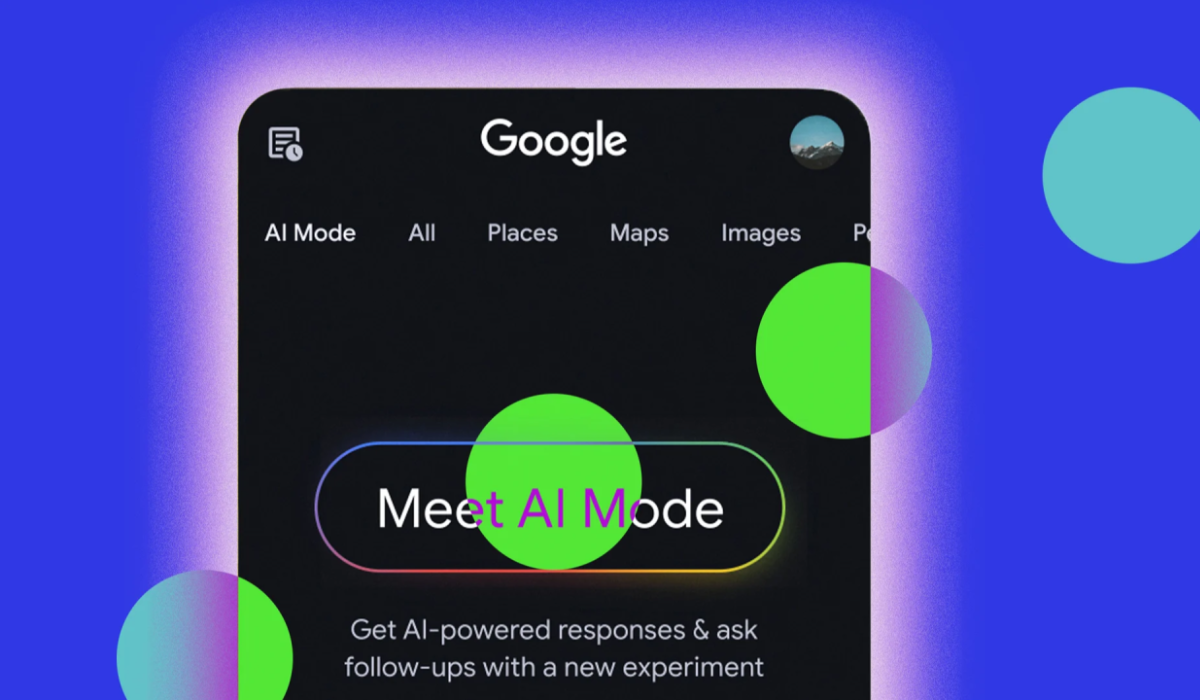


Google is turning AI Mode in Search from a question-answering tool into one that gets things done, letting you connect apps like Instacart, Canva, and YouTube Music and complete tasks without leaving your results. It’s rolling out in the US now, with more partners promised. The move pushes Search into the same agentic territory as ChatGPT and Claude.
Key Takeaways
- AI Mode can now link and act inside third-party apps
- Launch partners are Instacart, Canva, and YouTube Music
- You can build shopping lists, find designs, and make playlists
- It’s rolling out in the US, with more apps coming soon
- The update helps Google compete with ChatGPT and Claude
What Google Announced
Search is becoming more hands-on. Google announced Thursday that it now lets users link and interact with some of their go-to apps right in AI Mode, its conversational search experience.
The shift is from answering to doing. With this update, Google is expanding AI Mode beyond answering questions and into completing tasks across the apps people use regularly, so Search can act rather than just point you to links.
Three partners are first. At launch, the supported apps are Instacart, Canva, and YouTube Music, and Google says it’s working with a range of partners and plans to launch support for more apps soon.
Availability is limited for now. The rollout is going to users in the US, starting this week, with a wider expansion expected as Google adds integrations.
How It Works in Practice
Google offered a few concrete examples. If you’re planning a barbecue and using AI Mode to build a grocery list, you can connect your Instacart account to add the ingredients directly to your cart and check out on Instacart’s app or site.
The same handoff applies to creative work. If you’re working on a project and need design ideas, like for a flyer, you can ask Canva to show you a selection of templates without opening the app yourself.
Entertainment is covered too. You could use AI Mode to curate a playlist for your next party and instantly save it to YouTube Music, then start playing it, turning a search into a finished task.
Security is part of the pitch. Google says users can securely link and interact with their services in AI Mode, an emphasis aimed at the privacy concerns that have followed AI app integrations since the earliest chatbot plugins.
Building on the Gemini App
This isn’t Google’s first move in this direction. The announcement builds on a capability Google launched earlier this year at its I/O developer conference that lets users connect third-party apps to the Gemini app to complete tasks faster.
The Gemini version already spans several services. Supported apps there include Canva, OpenTable, Spark, and Instacart, among others, so Google is now extending that connected experience from its standalone assistant into mainstream Search.
AI Mode keeps expanding. Since launching in early 2025, Google has steadily added capabilities, and most recently it introduced the ability to check whether an item you need is in stock, a natural fit alongside shopping integrations.
The Competitive Picture
The update is squarely aimed at rivals. Both OpenAI’s ChatGPT and Anthropic’s Claude already support app integrations, and this rollout lets Google better compete by bringing similar task-completion into Search.
Google’s advantage is reach. Rather than asking users to adopt a separate assistant, it’s embedding agentic actions where billions of people already search, meeting them in a habit they already have.
There’s a business incentive too. Google is likely hoping people will lean on AI Mode more often for planning and shopping, deepening engagement with Search at a moment when AI assistants are competing to become the default place users start a task.
Why It Matters
This turns Search into an action layer. Instead of returning a list of blue links and leaving you to finish the job, AI Mode can now carry your instructions into other platforms and complete errands in the background.
It signals where Google thinks search is heading. Folding task completion into Search reframes it as a personal assistant rather than a lookup tool, a direct response to the agentic features reshaping how people use AI.
The open questions are trust and breadth. How comfortable users feel granting Search access to their accounts, and how quickly Google expands beyond three partners, will shape whether this becomes a core habit or a niche convenience. For now, Google has made its clearest move yet to make Search do the work, not just find it.
Digital Trendings is your trusted source for AI news and updates, stay tuned for more.