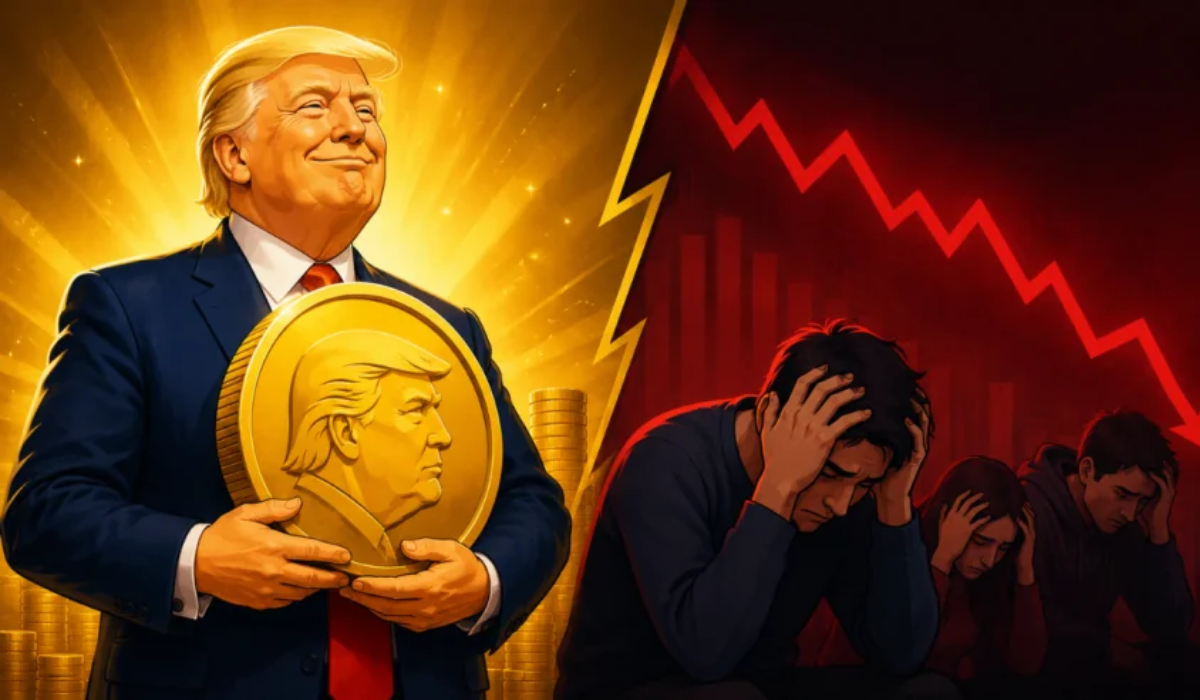


Nearly a million people who bought the $TRUMP memecoin are now underwater, losing a combined $3.8 billion, according to blockchain firm Nansen. Meanwhile, the president pocketed $636 million from the same coin. This post breaks down how the losses stacked up and who actually came out ahead.
Key Takeaways
- Nearly 1 million $TRUMP buyers lost a combined $3.8 billion total
- 988,905 accounts were underwater, about two of every three buyers
- $TRUMP trades near $1.71, down almost 98% from its $75 peak
- Trump earned $636 million from the coin he promoted to fans
- A small group of early traders captured roughly $4 billion in gains
The Scale Of The Losses
The numbers are brutal. Blockchain analytics firm Nansen found that 988,905 accounts had lost money on the $TRUMP memecoin as of the end of June. That’s roughly two out of every three buyers.
Their combined losses reached $3.81 billion. The analysis is based on transactions recorded publicly on the blockchain, so anyone can trace the flow of money between wallets.
The price tells the rest of the story. $TRUMP launched on the Solana blockchain on January 17, 2025, three days before the second inauguration. It surged to a record $73.43 within two days.
Today it sits far lower. As of July 5, 2026, the token trades around $1.71, down nearly 98% from the peak. Here’s how the collapse looks side by side:
| Metric | Value |
|---|---|
| Peak price (Jan 2025) | $73.43 |
| Current price (Jul 2026) | $1.71 |
| Decline from peak | ~98% |
| Peak market cap | ~$15 billion |
| Current market cap | ~$408 million |
| Wallets underwater | 988,905 |
| Total buyer losses | $3.81 billion |
The website for the coin had even warned buyers that it was not an investment. Most people bought anyway.
How Trump Profited Either Way
While buyers lost billions, the president made money. His financial disclosure, released by the Office of Government Ethics on June 30, listed $636 million in income tied to the $TRUMP coin alone.
That single payout accounted for nearly half of the $1.4 billion he earned from crypto ventures in 2025. The rest came largely from World Liberty Financial, a project run in part by his sons.
Here’s the key part. The coin’s price didn’t matter to his earnings.
- He collected transaction fees every time the token changed hands
- He profited whether prices rose or fell
- He pushed followers to trade the coin on Truth Social
CNN put it plainly, reporting that the memecoin’s price is meaningless to Trump because he earned fees on every trade regardless of direction.
The gap between promoter and buyer is stark. One wallet-level tally found his $636 million take was about 2.7 times the net gains across all buyer wallets. His entities also retained 80% of the token supply, released slowly through 2028.
Winners And Losers In The Same Market
Not everyone lost. A smaller group cleaned up.
Nansen data shows 492,285 wallets are up $4.04 billion, even as nearly 989,000 sit deep in the red. The split reveals who really won this game.
Early traders and automated bots got in first. They rode the launch spike, then sold into the excitement of slower retail buyers. Those late arrivals became what analysts call the exit liquidity.
The pattern is familiar in crypto. But Trump’s fame amplified it. Ross Gerber, a wealth manager, described the whole thing bluntly: a straight up grift of his own supporters.
Many buyers weren’t chasing profit at all. Some wanted to support the president. Others paid for access: top holders were invited to a black-tie dinner, and the 25 biggest got a VIP reception with Trump himself.
So the coin bought some people a handshake. It cost most of them money.
The Regulatory Gap Behind It
Here’s why buyers had no safety net. Memecoins fall outside most U.S. securities rules, so they skip the disclosure and antifraud protections that stock investors take for granted.
Congress hasn’t closed that gap. The GENIUS Act, signed in July 2025, created the first federal framework for stablecoins. But it contained no provisions covering memecoins or tokens issued by elected officials.
Europe went the other way. Its MiCA regulation reached full enforcement on July 1, 2026. It requires any crypto asset sold to the public to meet consumer protection standards, no matter what it’s called.
At the same time, U.S. enforcement eased. The SEC has dropped or paused nearly 60% of its crypto cases since Trump took office.
Some lawmakers want change. Senator Kirsten Gillibrand renewed her call on July 3 to bar officials from issuing tokens, stating flatly that public officials and their spouses should not be issuing memecoins. A similar measure was stripped from the GENIUS Act last year, and it faces long odds now.
Note: crypto assets are highly volatile and speculative. This article is informational, not financial advice.
Digital Trendings is your trusted source for AI news and updates, stay tuned for more.