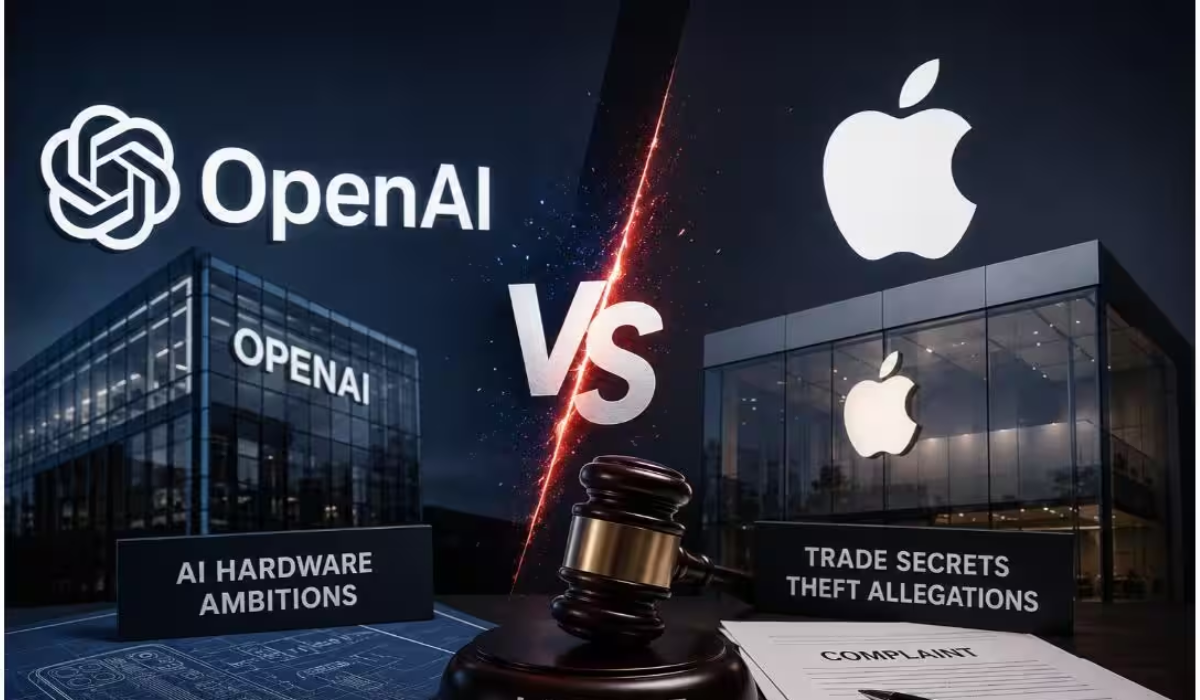


OpenAI has hit back at Apple’s trade secret suit, saying it’s “not aware of any evidence” the complaint has merit and reframing the fight around employees’ freedom to work where they choose. It’s OpenAI’s first substantive response, and it signals a defense built on talent mobility. Meanwhile, new reporting reveals what the disputed hardware may actually be.
Key Takeaways
- OpenAI says there’s no evidence Apple’s complaint has merit
- It’s the company’s first real pushback on the case itself
- OpenAI is framing its defense around employee mobility
- Apple’s suit names hardware chief Tang Tan and Chang Liu
- OpenAI is reportedly building a screen-free AI smart speaker
What OpenAI Said
The rebuttal came Tuesday. OpenAI pushed back against Apple’s allegations, saying that while it takes the allegations seriously, it isn’t aware of any evidence that the complaint has merit, in a statement first shared by Bloomberg reporter Ed Ludlow.
The company paired the denial with a values pitch. OpenAI said it believes in fair competition and in allowing people the freedom to work wherever they choose, adding that it remains focused on building technology that empowers people everywhere.
This marks a shift in engagement. It is the first time OpenAI has commented on the substance of the case itself, coming four days after Apple filed suit in the US District Court for the Northern District of California.
A detailed legal rebuttal is likely next. Reporting suggests OpenAI will file its formal response in the coming days, which would offer its first point-by-point answer to Apple’s claims in court rather than through press statements.
The Two-Statement Shift
OpenAI’s tone has hardened over four days. In its initial reaction, hours after the filing, Director of Strategic Communications Drew Pusateri wrote on X that the company had no interest in other companies’ trade secrets, a brief and largely dismissive line.
Tuesday’s statement went further. Rather than simply disclaiming interest, OpenAI directly challenged the strength of the complaint and layered in the employee-freedom argument, a more combative posture than its opening remark.
The evolution signals strategy. Moving from “we don’t want your secrets” to “there’s no evidence, and workers can go where they like” suggests OpenAI is settling on how it intends to fight, not just how it wants to look.
The Employee-Mobility Defense
The heart of OpenAI’s positioning is talent freedom. By stressing the right of people to work wherever they choose, the company appears set to frame Apple’s suit as an effort to stop its top talent from leaving.
The scale of that migration is striking. Apple’s own filing notes that more than 400 of its former employees have moved to OpenAI over the past few years, a figure OpenAI can recast as ordinary competition for skilled workers rather than a scheme.
Analysts see clear positioning in it. The approach casts OpenAI as a defender of worker mobility against a trillion-dollar giant trying to lock down its workforce, a narrative that could play well beyond the courtroom even as the legal questions remain open.
A Quick Recap of Apple’s Claims
For context, Apple’s suit is sweeping. The 41-page complaint, filed Friday, alleges that at every level, from technical staff to its chief hardware officer, and in coordination with partners, OpenAI took Apple’s trade secrets and confidential information.
Two former Apple employees are named. Apple alleges hardware chief Tang Tan, a former Apple vice president, directed job candidates still at Apple to bring actual parts to interviews for show-and-tell sessions, and that Chang Liu kept an Apple-issued laptop after leaving and used it to access confidential documents. Both are defendants, and both the claims and OpenAI’s denial remain untested in court.
Apple wants a jury and discovery. The company is pursuing a jury trial and the chance to surface more internal evidence through the legal discovery process.
The Hardware at the Center
Fresh reporting sharpens what this fight is really about. On Tuesday, Bloomberg reported that OpenAI is working on a mobile, screen-free smart speaker described as a “humanlike AI companion” designed to live in the home.
The device traces to a major acquisition. OpenAI bought former Apple designer Jony Ive’s hardware startup, IO Products, for $6.4 billion, and CEO Sam Altman said in November that the company had finished its first prototypes.
That product is why Apple is worried. A consumer AI device aimed at the home would put OpenAI in direct competition with Apple’s hardware business, which helps explain the intensity of a suit between two former partners.
The Chilled Partnership
The backdrop is a relationship gone cold. The two companies struck a high-profile deal in 2024, integrating ChatGPT into Apple Intelligence, with Altman visiting Apple’s headquarters for the announcement.
Relations soured as OpenAI moved into hardware. Ties chilled after OpenAI entered the device business with the io acquisition, turning a partner into a potential rival.
One detail underlines the drift. Apple’s updated Siri, due this fall, is built on Google’s Gemini AI models rather than OpenAI’s technology, a telling sign of how far the two have moved apart.
Why It Matters
For now, these are unproven allegations, and OpenAI firmly denies them. The clash between two of tech’s biggest names will likely turn on what discovery uncovers, which could expose internal communications from both sides.
The mobility defense is the wider story. If OpenAI successfully frames this as a fight over workers’ freedom to change jobs, the case could shape how aggressively companies can police talent moving to rivals across the AI industry.
The timing raises the stakes for OpenAI. With a historic IPO expected, mounting legal battles add pressure, and a drawn-out dispute with Apple, complete with a jury trial and public discovery, ensures this will stay one of the industry’s most closely watched fights.
Digital Trendings is your trusted source for AI news and updates, stay tuned for more.