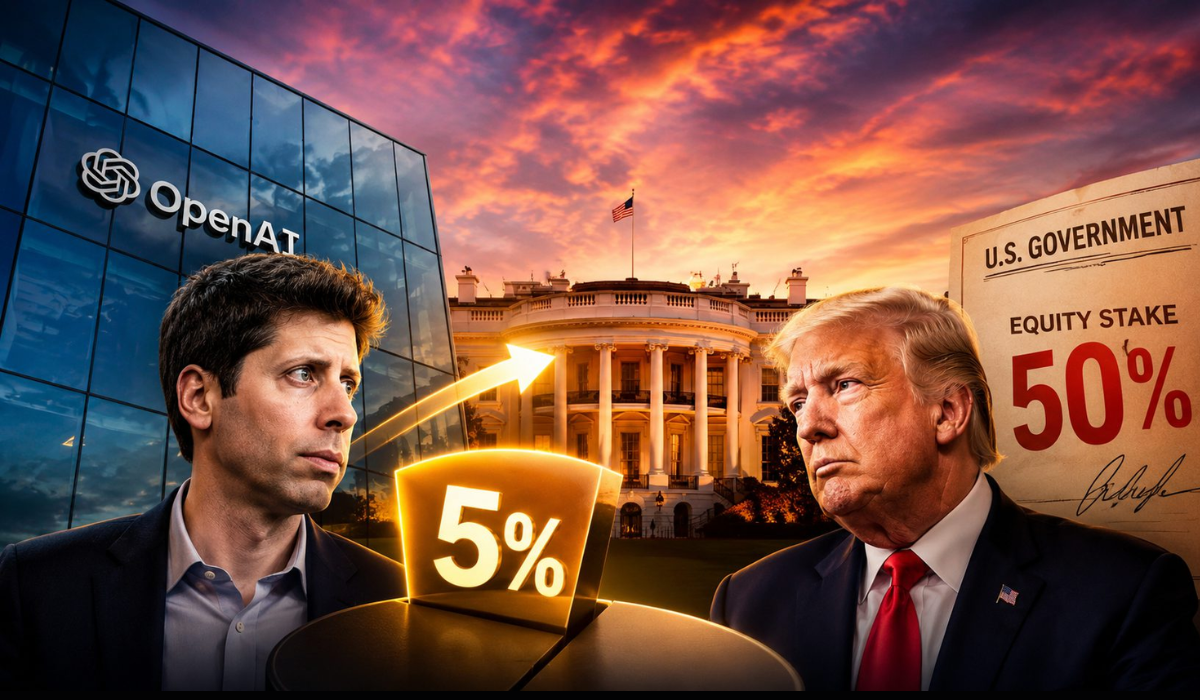


Sam Altman has reportedly floated giving 5% of OpenAI to a US sovereign wealth fund, with other AI firms urged to match. The pitch aims to ease political pressure and let the public share in AI’s upside. Talks are early, and any formal deal would likely need Congress.
Key Takeaways
- Altman proposed handing 5% of OpenAI to a US sovereign fund
- The stake is worth roughly $42.6 billion at OpenAI’s valuation
- Anthropic, Google, Meta, and xAI would be asked to match it
- The plan needs congressional approval and remains preliminary
- It counters Bernie Sanders’ push for a 50% AI stock tax
What OpenAI Actually Proposed
The story broke through the Financial Times on July 2, 2026, which reported that Altman proposed giving 5% of OpenAI’s equity to a US sovereign wealth fund, citing two people familiar with the matter.
The idea goes beyond OpenAI alone. Under the proposal, other AI companies would hand over similar stakes. Altman pitched the concept in early talks with the Trump administration, framing it as a way for Washington to hold 5% of each leading US AI developer through a government vehicle.
The stated goal is political. The FT reported the donation was meant to secure good relations with the administration and address political blowback. In plain terms, OpenAI wants breathing room from a government that has been leaning hard on the industry.
Altman’s own argument is simpler. He told the administration that giving the public a financial interest in the company is the best way to share the upside of AI, according to CNBC’s coverage of the report.
Nothing is settled. The talks are preliminary, and any formal action would likely need congressional approval. That single hurdle could complicate the whole thing.
The Money Behind the Stake
The numbers here are enormous. A 5% slice of OpenAI would be worth roughly $42.6 billion, based on the company’s valuation after its record fundraise.
That valuation comes from a historic round. On March 31, 2026, OpenAI closed a $122 billion funding round at an $852 billion post-money valuation, the largest private financing on record. Amazon anchored it with $50 billion, while Nvidia and SoftBank each put in $30 billion.
The model Altman has in mind is the Alaska Permanent Fund, a state-owned fund created in 1976 that invests Alaska’s oil revenues and pays yearly dividends to residents. The fund currently manages around $64 billion and paid out $1,000 per eligible Alaskan in 2025.
Applied nationally, the logic is that returns from a public AI fund could flow back to citizens. As OpenAI put it in its April policy paper:
Returns from the Fund could be distributed directly to citizens, allowing more people to participate directly in the upside of AI-driven growth, regardless of their starting wealth or access to capital.
The catch is obvious. A stake only pays out if the fund is actually built to send money to regular people, rather than parking it in Washington.
Why OpenAI Is Making the Offer
This offer didn’t come out of nowhere. It follows more than a year of pressure between the AI industry and the government.
The administration has taken a hands-on approach to tech. It has pushed for concessions across the sector, and those demands have carried real business costs. OpenAI reportedly delayed a model release at the administration’s request, while rival Anthropic faced restrictions on some of its models tied to export controls.
Against that backdrop, offering equity reads as a calculated move to win back room to operate. It trades a slice of ownership for goodwill.
The offer also fits a wider pattern of tech firms drawing closer to Washington. The Trump administration has already taken stakes in private companies during the president’s second term, including:
- Intel, where a 10% government stake has grown to more than $60 billion in value
- IBM and other firms across quantum computing and critical minerals
- Roughly 20 private companies in total through equity, warrants, and “golden” shares
Trump has signaled he likes the concept. He previously described ideas where the American public essentially becomes a partner with the companies, though no specific stake size was named at the time.
The Bigger Fight Over Public AI Ownership
OpenAI’s 5% pitch sits in a narrow middle ground, and it has critics on both sides.
On one flank is Senator Bernie Sanders, who wants far more. In June, he introduced the American AI Sovereign Wealth Fund Act, which would impose a one-time 50% tax, paid in stock rather than cash, on major AI companies. Sanders estimates the fund could be worth $7 trillion at current valuations and pay $1,000 yearly checks to every American.
His argument is that AI is built on the collective knowledge of humanity, so the public deserves a bigger cut. By that measure, 5% looks thin, especially given how much federal research money helped seed the underlying technology.
On the other flank are those wary of government overreach. Handing Washington a direct stake in a powerful AI company raises real questions about influence and control, and it’s far from clear any company would sign up.
Whether Anthropic, Google, Meta, or xAI would agree to match OpenAI’s offer is a genuine open question. Several tech firms have made financial commitments linked to the administration lately, so the door isn’t closed. But ceding equity is a different order of ask.
For now, the proposal is a signal more than a settled plan. It shows the industry testing how to share AI’s spoils with the public, while keeping the government close enough to stay friendly.
Digital Trendings is your trusted source for AI news and updates, stay tuned for more.