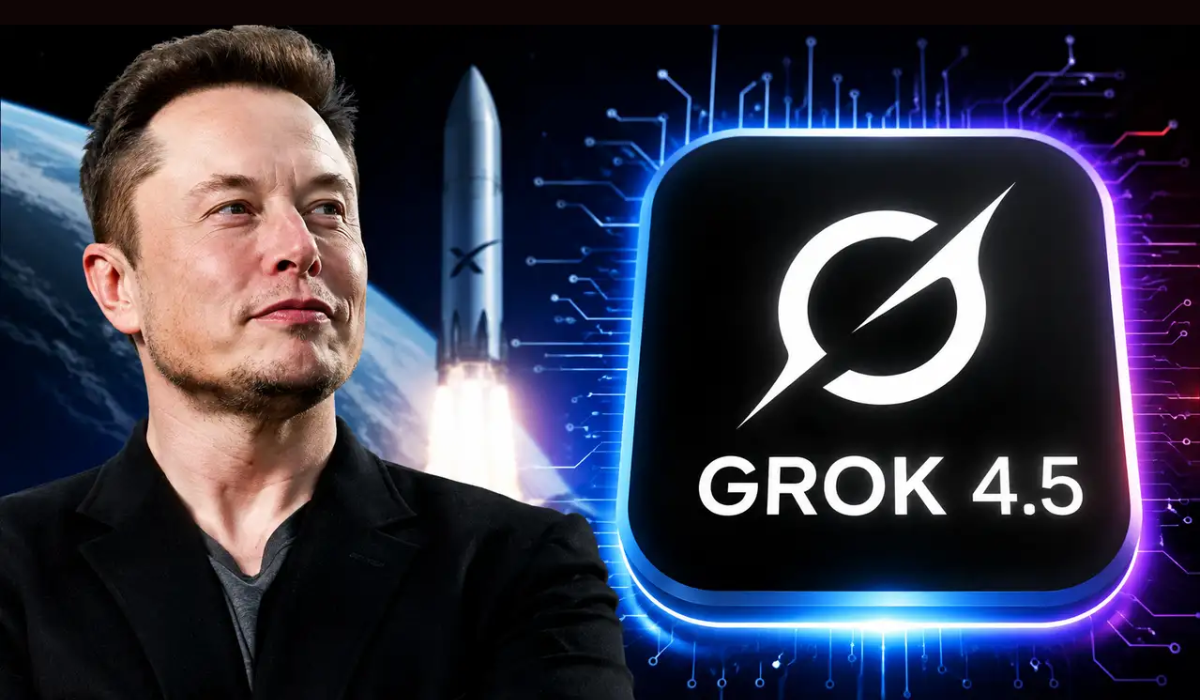


SpaceXAI has launched Grok 4.5, its first model built for coding and agents, trained with newly acquired Cursor. Elon Musk calls it “Opus-class, but faster, more token-efficient and lower cost.” The fine print is more measured: Musk himself pegs it against last year’s Opus 4.7, and the real pitch is price, not beating the frontier.
Key Takeaways
- SpaceXAI released Grok 4.5, its first coding-and-agents model
- Musk calls it “Opus-class,” but pegs it to last year’s Opus 4.7
- Priced at $2/$6 per million tokens, far below Opus 4.8’s $5/$25
- Co-trained with Cursor, the coding startup SpaceX is acquiring
- It trails Opus 4.8 and Fable 5 on most published benchmarks
What SpaceXAI Announced
The launch came straight from the top. In a post on X, which is a subsidiary of SpaceXAI, Musk said the company would make Grok 4.5 public and described it as an “Opus-class model, but faster, more token-efficient and lower cost”, referencing Anthropic’s LLM built for complex tasks.
The positioning is deliberate. Rather than a consumer chatbot, Grok 4.5 is pitched as a coding and agentic-work tool, one the company calls its first model trained specifically for coding and agents and one Musk frames as “maximally truth-seeking” versus rivals.
Availability was immediate on several surfaces. The model launched in Grok Build, in Cursor across all plans, and via the SpaceXAI console, though it is not yet available in the EU, with European access expected in mid-July.
The trigger, per Musk, was beta demand. He credited strong positive feedback from a beta program, reportedly SpaceX and Tesla engineering teams that ran it privately in late June, as the reason for moving to public release.
The “Opus-Class” Claim, Examined
Here’s where the headline needs a closer look. Musk’s own follow-up was notably more restrained than “Opus-class” implies, as he clarified that Grok 4.5 is roughly comparable to Opus 4.7, but much faster.
That distinction matters a lot. Opus 4.7 is Anthropic’s previous flagship, since superseded by Opus 4.8, and Anthropic’s current top-tier offering is Fable 5, which sits above both. So the comparison is to last year’s leader, not today’s.
Analysts read the label plainly. As one assessment put it, “Opus-class” is marketing shorthand more than a benchmark claim, with the strongest evidence for the comparison being cost and speed rather than raw capability.
The honest framing is a tradeoff. Musk presents Grok 4.5 as choosing speed and economics over chasing the absolute frontier, with engineers at Tesla and SpaceX cited as proof of real-world usefulness.
What the Benchmarks Actually Show
The published numbers tell a mixed story. On SWE-Bench Pro, Grok 4.5 posted 64.7%, ahead of some rivals but behind Opus 4.8’s 69.2% and Fable 5’s 80.4%, placing it in the pack rather than at the top.
Other coding evals echo that. On the DeepSWE bug-fixing test, Grok 4.5 scored 53%, trailing Opus 4.8, GPT-5.5, and Fable 5, so on pure resolution rate it lands third-tier among the frontier crowd.
It does claim some wins. Grok 4.5’s clearest edge came on the SWE Marathon resolution rate, where it scored 29.0% against Opus 4.8’s 26.0% and Fable 5’s 24.0%, and it roughly tied GPT-5.5 on Terminal Bench.
Independent testing puts it near, not at, the frontier. Artificial Analysis ranked Grok 4.5 number four of 168 models on its Intelligence Index, behind only Fable 5, GPT-5.5, and Opus 4.8, a strong result that still leaves it just short of best-in-class.
The Real Pitch: Efficiency and Price
Strip away the “Opus-class” label and the compelling story is cost. Grok 4.5 is priced at $2 per million input tokens and $6 per million output, against Opus 4.8’s $5 input and $25 output, a steep discount.
Token efficiency sharpens the edge. On SWE-Bench Pro tasks, Grok 4.5 used an average of 15,954 output tokens per job versus about 67,020 for Opus 4.8, a roughly 4.2x gap that compounds into real savings at volume.
Speed rounds out the argument. The model runs at about 80 tokens per second, firmly in fast-model territory, though with reasoning on by default its time-to-first-token is relatively slow.
So the value proposition is capability-per-dollar. For teams running high-volume coding work, the math can favor Grok 4.5: roughly Opus 4.7-level capability at a fraction of the price and far fewer tokens burned, even if it doesn’t win the benchmark crown.
The Cursor Connection and Corporate Backdrop
Grok 4.5’s specialty comes from a partner. It was co-trained with Cursor, the AI coding startup SpaceX is in the process of acquiring, using developer session data like debugging traces and real code edits rather than static repositories.
The underlying model is a big step up. Grok 4.5 runs on xAI’s new V9 foundation at roughly 1.5 trillion parameters, about three times the scale of the architecture behind earlier Grok 4 variants, and it was trained on tens of thousands of Nvidia GB300 GPUs inside the Memphis supercomputer, Colossus.
The corporate structure is unusual. This is SpaceXAI’s first public model since the SpaceX-xAI merger closed in February, with X folded in as a subsidiary, an arrangement that still has many outlets using “xAI” and “SpaceXAI” interchangeably.
One tension looms over it all. Grok 4.5 was trained using the same compute SpaceXAI leases to competitors like Anthropic and Google, so as its own needs grow, the company may face a choice between powering its own models or renting that capacity out as revenue.
Why It Matters
The launch stakes a claim in a hot market. SpaceXAI is explicitly targeting the coding-agent workflow space recently dominated by Anthropic and OpenAI-style tool-using systems, competing on economics rather than outright benchmark supremacy.
The roadmap is aggressive. The company says it plans to release a new foundation model roughly every month through the end of 2026, signaling intent to close the capability gap fast, with a much larger Grok 5 already in training.
The timing was pointed too. Grok 4.5 landed a day before OpenAI’s wider release of GPT-5.6, making it a crowded week for model launches and underscoring how relentless the release cadence has become.
The recurring pattern is the real takeaway. SpaceXAI keeps showing up with enormous compute and competitive-but-not-first scores, and Grok 4.5 fits that mold. What changed this time is the pricing and the training signal, and for cost-conscious teams, that may matter more than a top-of-chart benchmark they’ll never fully use.
Digital Trendings is your trusted source for AI news and updates, stay tuned for more.